Railway - easy deployment
This project is deployed on Railway. For me it works like a charm: I just add my repo and Railway builds and deploys it by itself. This link gives $20 in credits. No pressure - use if it fits your stack.
Example
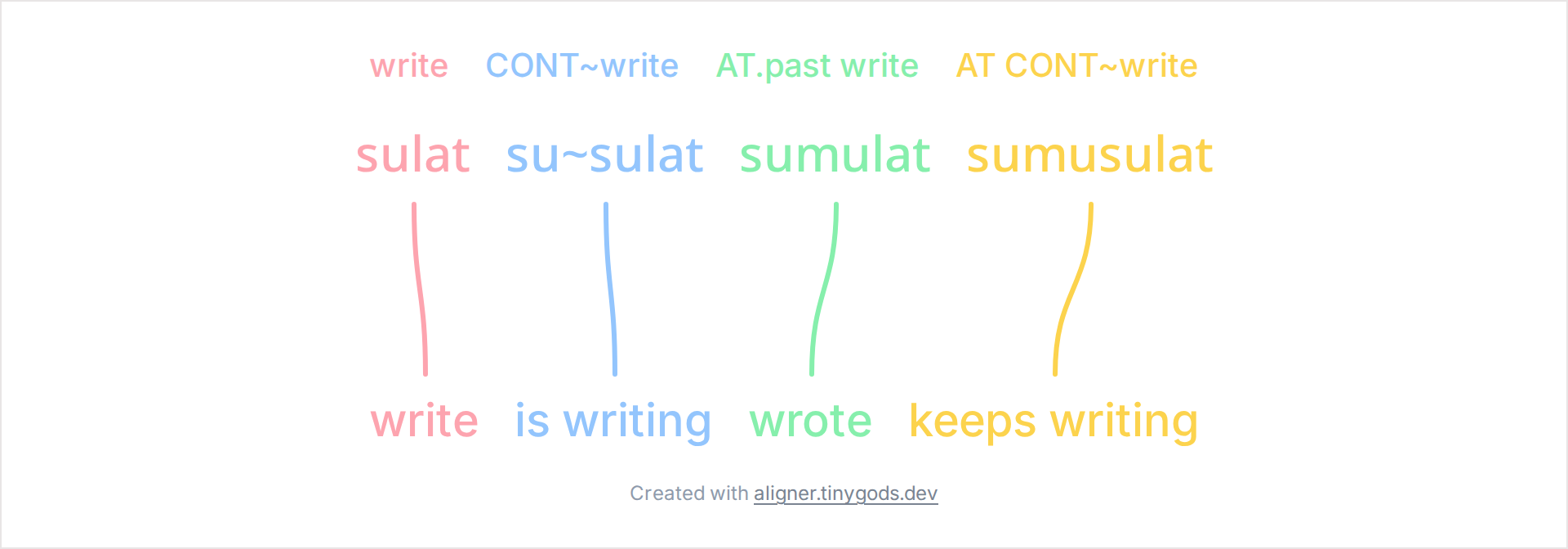
Example layout based on an example in the Wikipedia article Interlinear gloss (illustrative; Leipzig-style conventions).
Instead of one sentence, this diagram lays out several forms of the Tagalog verb sulat (“write”) side by side. Each form changes the aspect or mood through reduplication and an infix. Reading them together shows the pattern at a glance, which is why a paradigm makes a good morphology cheat sheet.
The base and three derived forms:
A paradigm diagram puts related forms in parallel so the reader compares them top to bottom rather than left to right. The shared stem sulat stays constant while the affixes change, and the gloss line names what each change does. This is a different use of the tool from a single sentence: the rows are not one clause but a set of contrasts.
Reduplication is written with a tilde, as in su~sulat, and a period inside a label joins meanings that one affix carries at once. The agent trigger and aspect labels follow the standard set.
For the labels and marks:
Open the example and treat each row as its own short line with a gloss above it. Adjust the gaps so the forms read as a stacked table, then export the paradigm as PNG, SVG, or PDF for a handout.
Related Tagalog examples:
This project is deployed on Railway. For me it works like a charm: I just add my repo and Railway builds and deploys it by itself. This link gives $20 in credits. No pressure - use if it fits your stack.