Cursor — AI code editor
Cursor is my main AI coding tool. If you were going to try it anyway, this referral gives new accounts 50% off the first month of Pro, Pro+, or Ultra (per Cursor’s current offer).
Example
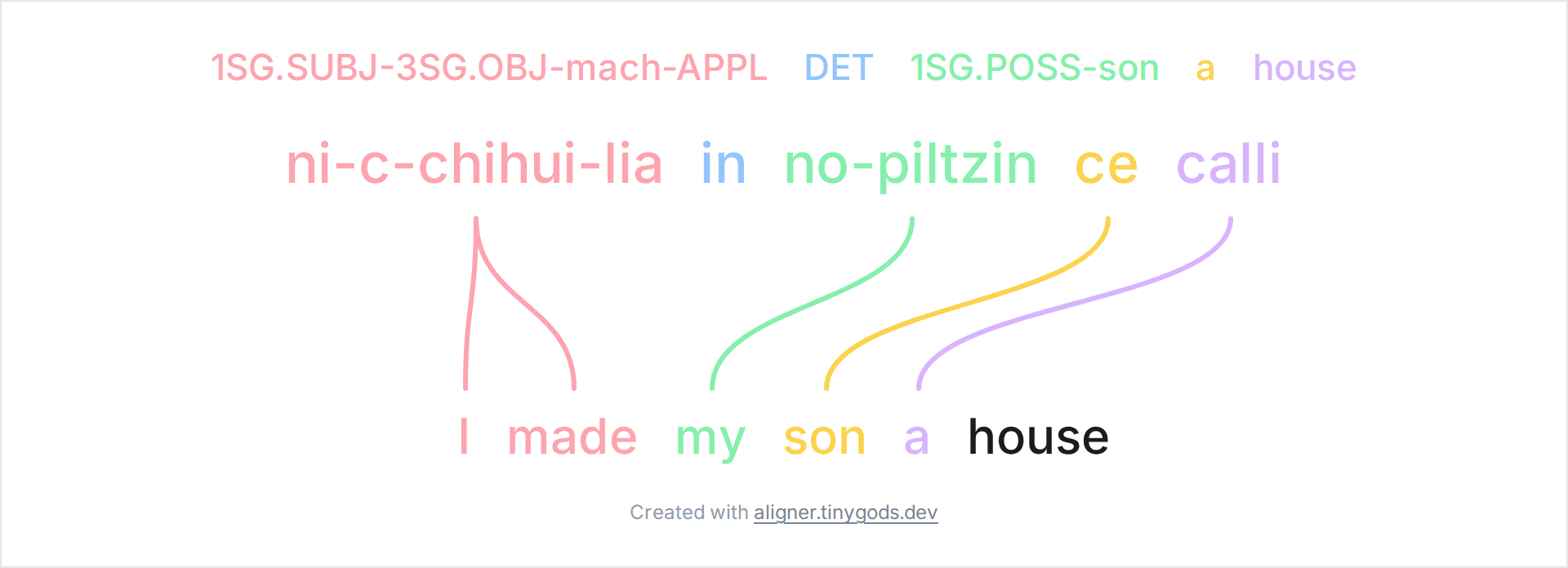
Example layout based on an example in the Wikipedia article Interlinear gloss (illustrative; Leipzig-style conventions).
This is the same Nahuatl clause as the word-by-word version, but the gloss line is written the way grammars and journals write it: with category labels instead of full English words. 1SG.SUBJ stands in for “I”, 3SG.OBJ for the object, and APPL for the applicative. It is the format an author uses when preparing interlinear text for publication.
A teaching gloss writes “make” and “my” so a beginner can read it. A publication gloss writes APPL and POSS, which are compact and unambiguous to a linguist. The morphemes and their boundaries stay the same; only the labels change. Keeping the hyphens aligned means the tag line and the source line have the same number of pieces.
A period inside a label, as in 1SG.SUBJ, ties several meanings that one morpheme carries at once. APPL marks the applicative, which adds a beneficiary to the verb. These tags are part of the standard Leipzig set.
For the full set:
Open the example and edit the gloss line to switch between teaching labels and journal tags. Tighten the gap between the gloss and the source so the block reads as one unit, then export it as PNG, SVG, or PDF for a paper or a grammar.
Related examples:
Cursor is my main AI coding tool. If you were going to try it anyway, this referral gives new accounts 50% off the first month of Pro, Pro+, or Ultra (per Cursor’s current offer).