Railway - easy deployment
This project is deployed on Railway. For me it works like a charm: I just add my repo and Railway builds and deploys it by itself. This link gives $20 in credits. No pressure - use if it fits your stack.
Example
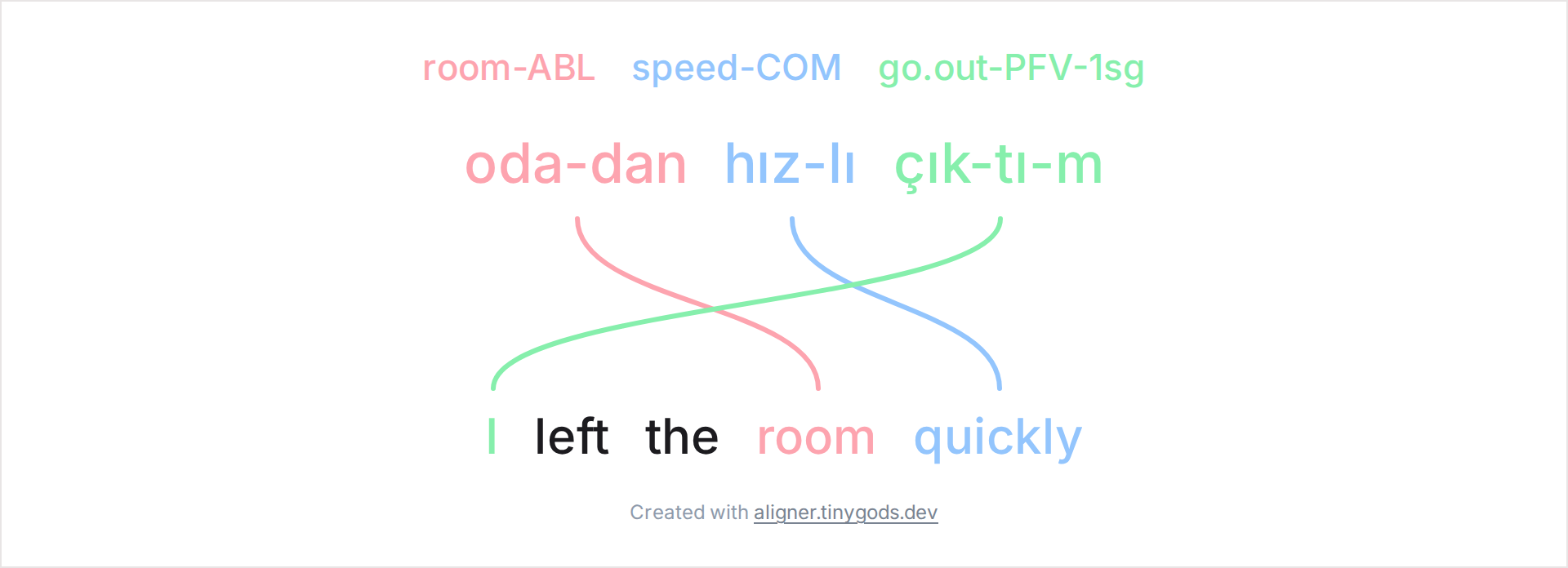
Example layout based on an example in the Wikipedia article Interlinear gloss (illustrative; Leipzig-style conventions).
Turkish builds a whole clause by gluing suffixes onto a few stems. The sentence Odadan hızlı çıktım means “I left the room quickly”, and every grammatical detail rides on a suffix rather than a separate word. Lined up against English, the alignment shows where one language uses a suffix and the other a full word.
Three Turkish words carry what English spreads across five. Each token with its gloss:
English puts the subject and verb first: “I left the room quickly.” Turkish keeps the verb last and packs case and person into suffixes. The link from oda-dan runs to “room” in the middle of the English line, while the link from çık-tı-m runs back to “I left” at the start, so the two connectors cross. In flat text that reordering is easy to miss; the diagram makes it visible at a glance.
Turkish is agglutinative: one suffix carries one meaning, and the suffixes stack in a fixed order. çık-tı-m reads as stem, then aspect, then person, left to right. English splits the same information into separate words and word order. A single Turkish column of stacked suffixes faces three English positions.
Each suffix gets its own hyphen-aligned gloss, so the source line and the gloss line carry the same number of hyphens. The labels ABL, COM, PFV, and 1SG are standard Leipzig tags for ablative case, comitative, perfective aspect, and first-person singular.
For the full set of these labels:
Open the example in the editor, then add an IPA line above the Turkish or a free-translation line below. To keep a suffix attached while you experiment, set the morpheme boundary character under Settings → Tokens. Export the finished diagram as PNG, SVG, or PDF for a handout or slide.
Related phenomena in other examples:
This project is deployed on Railway. For me it works like a charm: I just add my repo and Railway builds and deploys it by itself. This link gives $20 in credits. No pressure - use if it fits your stack.