Railway - easy deployment
This project is deployed on Railway. For me it works like a charm: I just add my repo and Railway builds and deploys it by itself. This link gives $20 in credits. No pressure - use if it fits your stack.
Example
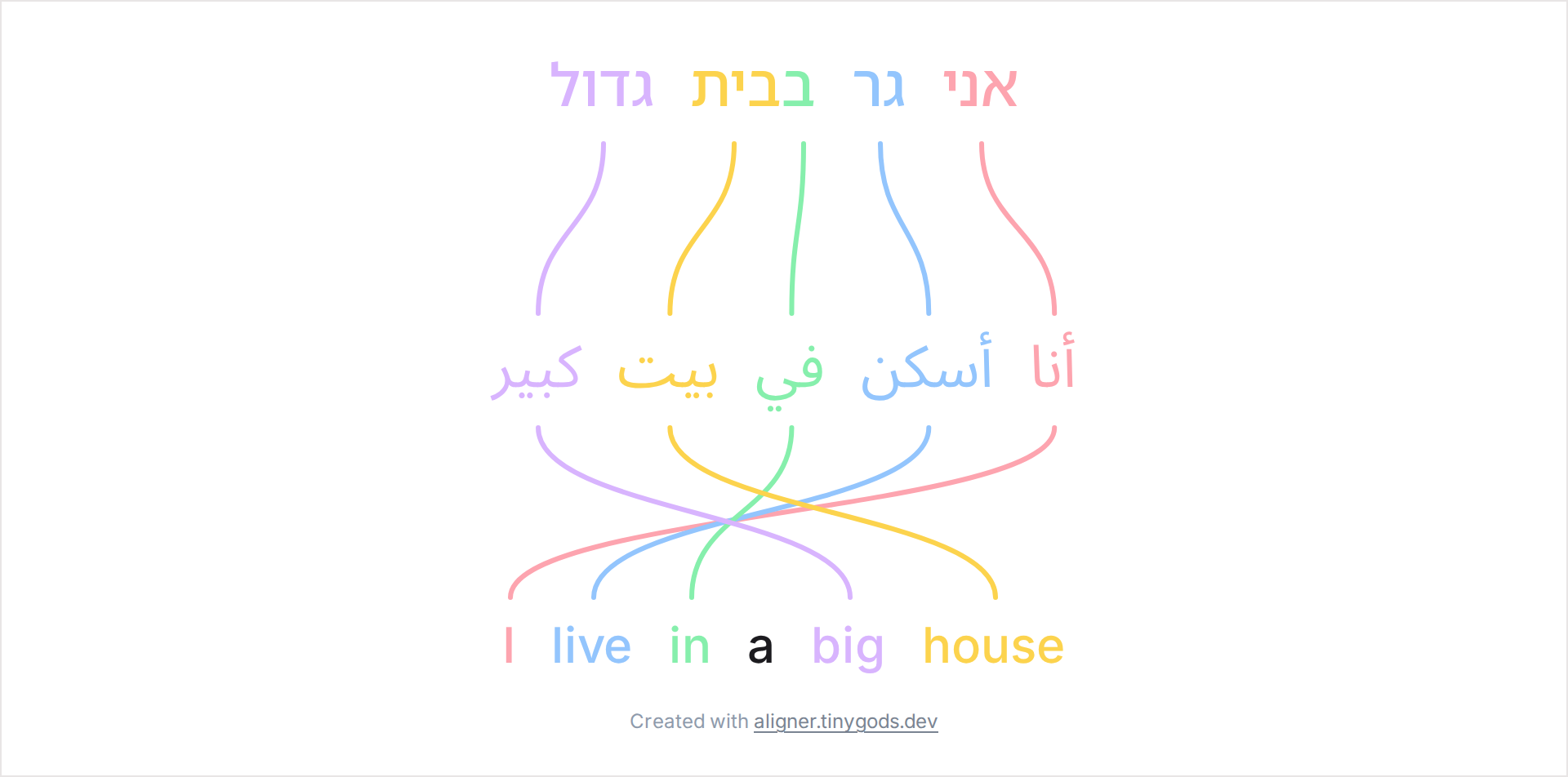
Hebrew and Arabic both run right to left. Here Hebrew sits on top, Arabic in the middle, and English below, so two related Semitic languages line up against the same translation. The diagram makes two things visible at once: how each language attaches a preposition, and where word order pulls the connectors across each other.
The same English “in” attaches differently in each language:
Arabic places an adjective after its noun, while English places it before. When the same two words appear in opposite order, the link from the noun and the link from the adjective swap sides and cross. In plain running text that reordering is hard to spot; the crossing curves point straight at it.
Turn on right-to-left for each Hebrew or Arabic line from the line popover, and leave the English line left to right. The tool keeps the connectors correct across the direction change, so you can mix RTL and LTR rows in one diagram. The same switch works for other right-to-left scripts.
If you add a gloss line, the labels come from the
Related examples:
This project is deployed on Railway. For me it works like a charm: I just add my repo and Railway builds and deploys it by itself. This link gives $20 in credits. No pressure - use if it fits your stack.