Wise — international transfers
Sometimes I have trouble with money transfers in my country. Wise worked for me without too much hassle. With this invite, new sign-ups get a fee-free first transfer up to roughly US$600 equivalent.
Example
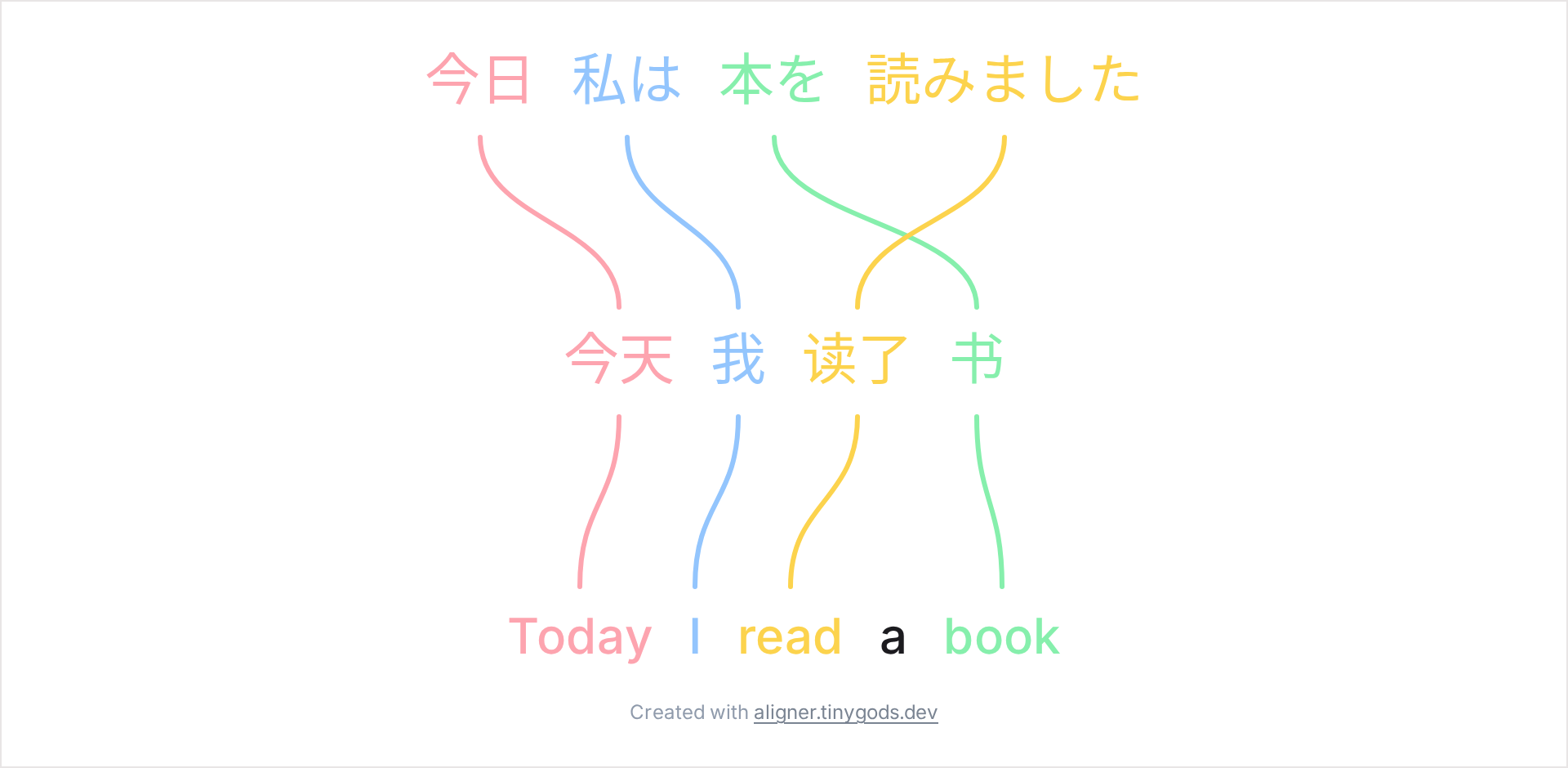
Japanese, Chinese, and English describe the same event but arrange the words differently. Japanese puts the object before the verb, while Chinese and English put the verb before the object. Lined up in three rows, the diagram shows where that difference forces the connectors to cross.
The verb and the object sit in opposite order across the languages:
Japanese and Chinese do not put spaces between words in normal writing, so the tool needs a cue for where one token ends and the next begins. Here spaces are added in the source lines to mark those boundaries, which lets each token become its own clickable box for linking.
Stack a gloss line for grammatical labels or an IPA line for pronunciation above either source language. The grammatical labels follow the standard Leipzig set.
For those labels:
More word-order and crossing examples:
Sometimes I have trouble with money transfers in my country. Wise worked for me without too much hassle. With this invite, new sign-ups get a fee-free first transfer up to roughly US$600 equivalent.